The concessions come with a combined investment target of BRL 140 billion, equivalent to approximately EUR 26 billion. According to official estimates, the total impact on the national rail system is projected at BRL 600 billion (around EUR 111 billion) when including broader economic effects and associated investments.
The new concession model introduces changes in project structuring and financing mechanisms. These include adjusted economic models for each project, rules on public-private investment flows, and an updated contractual framework addressing environmental licensing, social responsibility, and the use of third-party rolling stock. The approach is designed to allow greenfield projects to be developed directly by concessionaires, without requiring prior public works contracts.
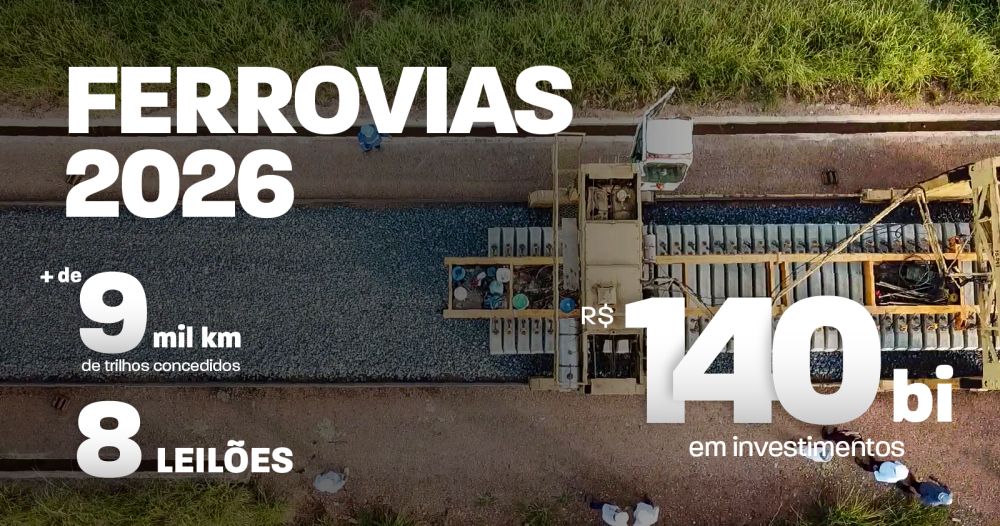
Among the eight rail corridors planned for concession, several are already known to the sector. These include the Ferrogrão line, intended to connect Sinop in Mato Grosso to Itaituba in Pará, and the Southeast Railway Ring (EF-118), which will be auctioned in two phases. Also included are the Leste-Oeste Corridor, the Minas-Rio Corridor, and the Malha Oeste and Malha Sul segments, the latter split into corridors for Paraná–Santa Catarina, Rio Grande do Sul, and the Mercosur route.
The auction schedule spreads across 2026 and early 2027, with calls for tender beginning as early as March 2026 for the Minas-Rio Corridor. The first auctions are planned for April and May, while later projects like the Ferrogrão are expected to be auctioned towards the end of the year. The North Extension of the North-South Railway is scheduled for early 2027.
In total, the Ministry of Transport’s wider plan includes 21 auctions combining road and rail concessions, with a total projected investment of BRL 288 billion (EUR 53 billion).