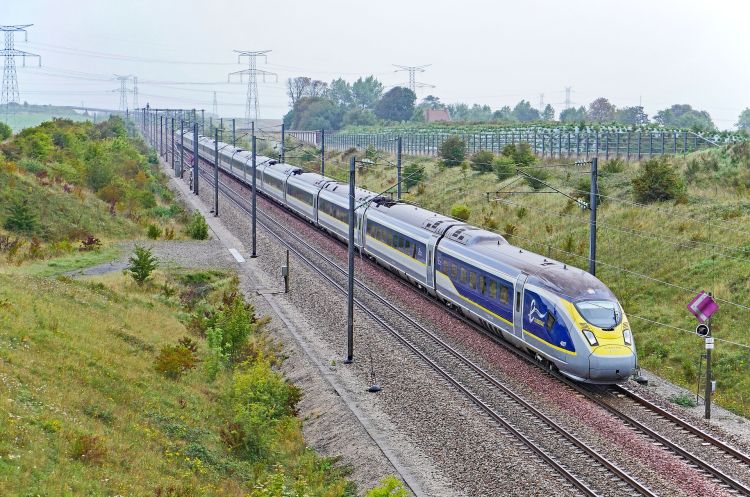
Eurostar, the high-speed rail network linking France, Belgium, the Netherlands, Germany, and the UK, unveils its ambition to enable 30 million passengers to travel sustainably. One of Eurostar's key objectives is to work with partners and regulators to power its trains with 100% renewable energy by 2030. Eurostar's sustainability strategy, detailed in its first sustainability report, focuses on three main areas.
“Eurostar now has the opportunity to draw on a global network of over 400 companies as it works towards 30 million journeys a year powered by 100% renewable electricity by 2030. We encourage other businesses in the rail sector to follow Eurostar’s lead and commit to 100% renewable electricity,” commented Ollie Wilson, Head of RE100, Climate Group.
1) Reduce its impact by sourcing renewable energy for its traction needs and reducing its energy demand. For example, through the MoU signed with Infrabel in February 2024 to explore the installation of novel solar projects for traction.
2) To integrate circularity throughout the value chain, from production to end-of-life, to minimize waste and make more efficient use of resources. For example, every meal on board is carefully curated with sustainable sourcing and eco-friendly options in mind. Such efforts have already been rewarded, with Eurostar receiving a three-star rating from the Food Made Good Awards for its onboard catering.
3) Attract more passengers to its low carbon service by developing 'open hubs' to connect Eurostar services to domestic networks or long-haul flights, for example through its air-rail partnership with KLM.
"To achieve our goal, we work closely together with our partners in each of our markets, we encourage regulatory support for the rapid deployment of new renewable energy projects,” explained commented Eurostar CEO Gwendoline Cazenave.