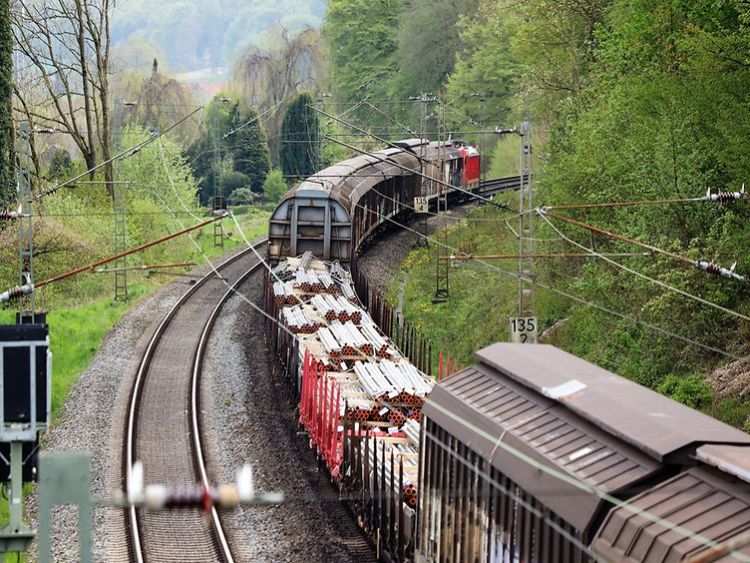
DB Cargo, the freight division of Deutsche Bahn, continues its extensive restructuring program as it seeks to reverse years of financial losses. This was reported by RedaktionsNetzverkehr Deutschland, in the recent interview with Sigrid Nikutta, who is leading the company.
DB Cargo, which posted an operating loss of over €350 million in 2024, faces pressure to become financially self-sustaining by the end of 2026. The change in status follows the termination of profit and loss transfer agreements between DB AG and DB Cargo, in line with EU competition law. These adjustments remove the possibility of state-funded compensation for losses from 2026 onward.

According to Nikutta, the freight subsidiary must now operate independently and respond to market forces. The restructuring program includes workforce reductions, decentralization of operational units, and targeted productivity increases. Approximately 5,000 jobs are planned to be cut by 2028, with over 1,500 employees already reassigned, retired early, or voluntarily departed as of early 2025. Layoffs have been implemented in one specific business unit where internal job transfer systems are not in place.
Shift toward decentralized business units and new work models
Since January 2025, DB Cargo has operated through seven smaller, medium-sized units designed to carry individual performance accountability. This move toward decentralized governance aims to align cost structures more closely with service output. Parallel to the organizational changes, adjustments to the work model for train drivers have been introduced.
A segment of train drivers now works on extended-distance routes across multiple days, receiving bonuses in exchange for longer tours. These drivers have contributed to a 20% productivity increase, according to internal figures. For others, scheduling flexibility has increased, including shift starts and ends outside designated DB Cargo facilities and within broader geographical parameters.
Digital and technical initiatives underway, progress remains uneven
Efforts to modernize operations include the use of automated systems and artificial intelligence. DB Cargo has installed 16 overhead camera bridges to scan passing trains for external damage. These scans are processed using AI to detect micro-defects such as tarpaulin damage that could lead to corrosion issues. The technology has reportedly gained traction among clients in the steel industry, where quality requirements are high.
In contrast, the rollout of digital automatic couplings remains slow. The implementation requires a coordinated European approach, and although the technology is now acknowledged in EU policy frameworks, large-scale testing and deployment remain pending. Plans include operating 100 trains across 18 countries as part of the proof-of-concept phase.
Single wagonload transport and track access charges raise questions
DB Cargo continues to cite single wagonload transport as a financially unviable segment. The company attributes approximately 80% of its losses to this area, which despite holding a 90% domestic market share, secures only 60% of the available subsidy allocation. Current support mechanisms, including subsidies for short block trains and plant logistics, are considered insufficiently targeted. Concerns have also been raised about unused competitor subsidies that are not redistributed.
At the same time, infrastructure charges have added pressure. A 16% increase in track access fees in Germany took effect in January 2025. The higher costs come as DB Cargo and others in the freight sector call for a pricing structure that supports modal shift objectives.
Military logistics resurface in freight planning
With geopolitical uncertainty prompting renewed focus on national defense, DB Cargo’s role in military logistics has also returned to strategic planning discussions. The company is expected to contribute to the strengthening of transport and rail infrastructure in support of defense readiness. Leadership indicates that investments in capacity and network resilience will be necessary to meet these demands.
DB Cargo Outlook for 2025
DB Cargo targets a reduced operating loss in 2025, potentially in the lower triple-digit million euro range. However, multiple variables — including the economic environment, subsidy structures, and infrastructure costs — are expected to influence the final outcome. Management maintains that speed of implementation will be central to meeting the 2026 target for financial independence.