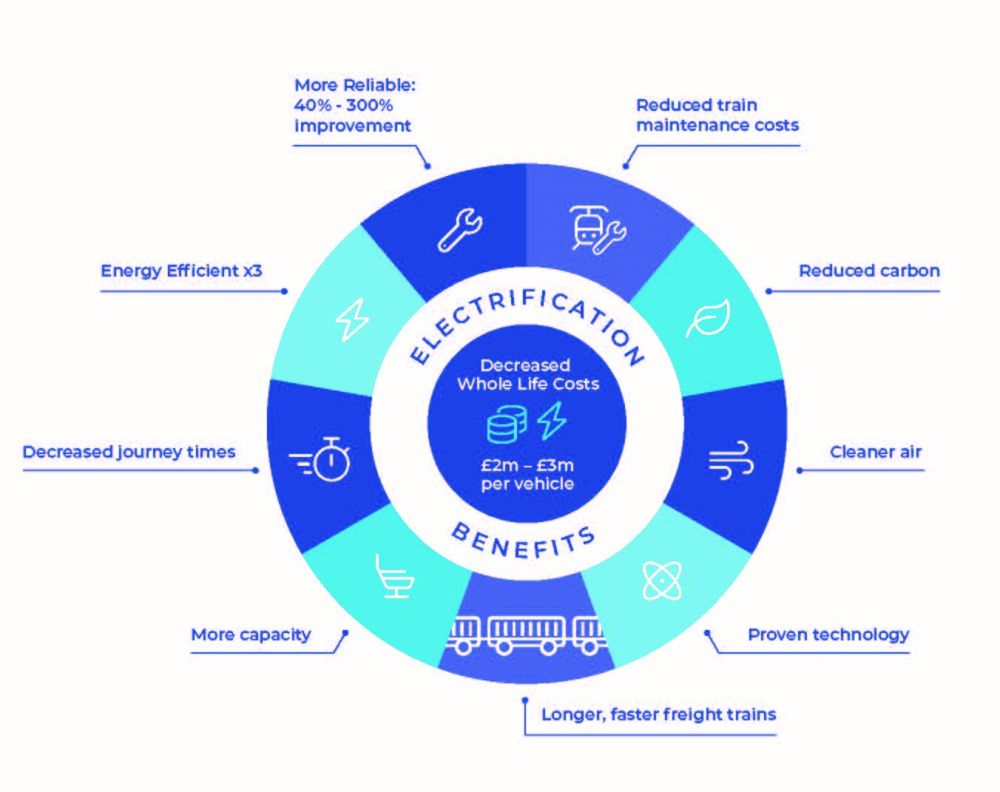
The Railway Industry Association (RIA) has released a new paper outlining the many benefits of rail electrification above and beyond decarbonization. The paper, which was released in conjunction with the RailDecarb23 campaign, aims to highlight the advantages of rail electrification, including lower costs, increased reliability, improved efficiency, reduced journey times and capacity, and faster and longer electric freight trains.
The paper "Rail Electrification: The Facts" argues that an electric railway is the cheapest to operate over the lifetime of a train, even when the construction costs of electrification are taken into account. Electric trains are also 40% to 300% more reliable than diesel trains and three times more efficient than diesel or hydrogen trains, which can reduce energy requirements. In addition, electric trains accelerate faster, allowing more trains and capacity on a route. From a freight perspective, electric freight trains are faster and longer, helping to take trucks off the road and increasing passenger capacity.
Co-author and Director at Furrer+Frey, Noel Dolphin, said: "An electric railway is the most efficient method for transporting passengers and freight, ultimately resulting in long-term reduced operational costs." He added that this not only helps to decarbonize the industry but also paves the way for a superior railway experience that is more reliable, cost-effective, and able to accommodate increased capacity.
David Clarke, RIA's technical director, called on the UK government to accelerate the pace of rail electrification, saying that the current pace and trajectory of rail electrification is insufficient to meet the goal of removing all diesel-only trains from the network by 2040 and achieving a net-zero railway by 2050. According to official statistics, only 2.2km of rail was electrified in 2021/22.