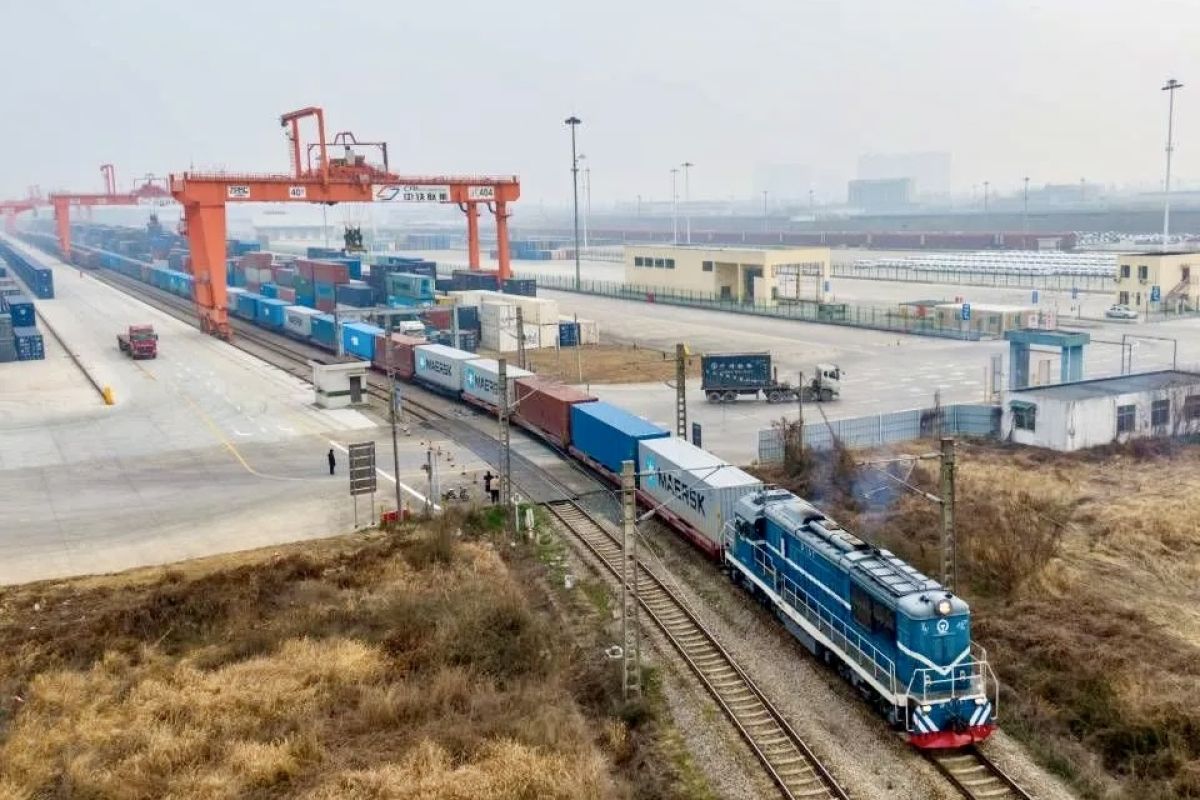
The first China–Europe block train has departed from Wuhan, bound for Azerbaijan via the Trans-Caspian International Transport Route, also known as the Middle Corridor.
According to Azertag, the first direct freight service from Wuhan to Baku is carrying electronic equipment, household appliances and everyday consumer goods to European markets.
After passing through the Khorgos border crossing in China’s Xinjiang Uyghur Autonomous Region, the train will continue across the Caspian Sea before reaching Azerbaijan’s capital, Baku.
Azerbaijan Railways (ADY) will then transfer the cargo from Baku Port onto container block trains bound for Europe.
This multimodal journey, combining rail and maritime transport, is expected to take around 18 days, compared to up to 22 days on conventional routes.
The new connection is expected to support export-oriented companies in Hubei, offering a more stable and efficient logistics option for accessing Eurasian markets.
Wuhan has developed into a key hub for China–Europe rail services, linking central China with more than 100 cities across over 40 countries through a network of more than 50 routes. Services primarily depart from the Wujiashan and Xianglushan railway stations, carrying a wide range of cargo including electronics, automotive components and consumer goods.
The network is set to expand further in 2025 and 2026, with new routes strengthening Wuhan’s role in Eurasian logistics. Recent additions include direct services to Northern Europe, such as Copenhagen, alongside the new connection to Baku via the Middle Corridor.
Key destinations include major logistics hubs such as Hamburg, as well as cities in Poland, Russia and the Nordic region.
Wuhan’s rail services also benefit from integrated customs clearance at Xianglushan Station, supporting faster and more streamlined operations.
From a broader perspective, the Middle Corridor is gaining importance as an alternative Eurasian route, offering lower geopolitical risk and more resilient supply chains compared to traditional corridors.
The route spans approximately 4,250 kilometres of railway and 500 kilometres of maritime links, connecting China and Central Asia with Europe via the Caspian Sea, Azerbaijan, Georgia and Turkey.
In addition to shorter transit times, the corridor benefits from favourable climatic conditions and enables connections further to the Middle East, North Africa and the Mediterranean via Turkish ports.
Since 2022, cargo volumes along the Middle Corridor through Azerbaijan have increased by nearly 90%. In 2025 alone, ADY handled more than 380 block trains from China, a 35% increase year-on-year, with total volumes reaching 137,000 TEUs, up by around 20%.
This article was originally published on newsilkroaddiscovery.com